
AI email assistant review
Skim review
Open sourceBest for: Windows 10/11 users who prefer a lightweight, keyboard-first, local-first mail client; people with multiple Gmail, Outlook, Yahoo, iCloud, or IMAP accounts; technical users who want BYOK or a local model; and users who want mailbox Q&A and drafting without a separate SaaS subscription.
Our review
The full take on Skim
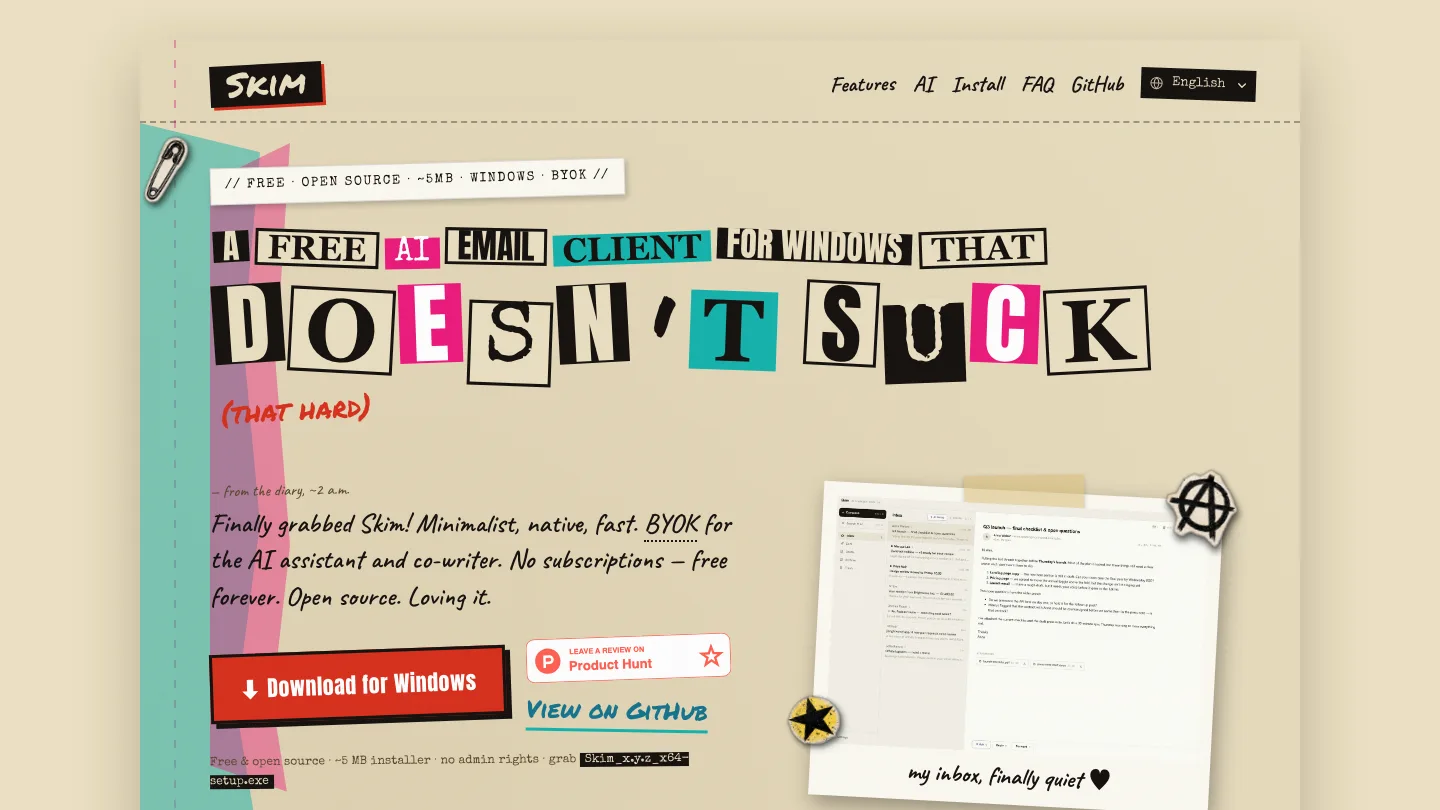
Skim is a free, MIT-licensed Windows email client with optional bring-your-own-key AI for drafting, iterative rewriting, unread-mail recaps, questions about threads, and cited search across a locally indexed mailbox. It is best for Windows users who want a small, keyboard-first alternative to Outlook and are comfortable supplying an Anthropic, OpenRouter, OpenAI-compatible, or local-model endpoint. The main limitations are Windows-only distribution, a very young product and community, limited independent testing, and a Gmail OAuth path that the project itself says can require weekly reauthentication unless the user chooses an app password.
Features and fit
What Skim does
Draft replies in a selected style or a voice profile derived from up to 100 sent messages; refine the current draft conversationally; answer questions about a message or thread; retrieve and answer questions across the mailbox with cited source-email chips; recap up to 20 unread messages with reply priorities and deadlines; translate replies; and pass date, time, timezone, interface language, and relevant thread context to the model.
Product type
Native Windows desktop email client built with Tauri 2, a Rust core, and the system WebView2. It is open source under the MIT license and is not a browser extension or hosted email service.
Email and platform support
Gmail, Outlook.com/Hotmail, Microsoft 365/Exchange Online, Yahoo, iCloud, and other mailboxes that expose standard IMAP/SMTP. The current README recommends a Gmail app password because the project's one-click Google OAuth flow has not completed the annual security assessment and can require weekly reauthentication.
AI providers
Anthropic, OpenRouter, and OpenAI-compatible endpoints, including OpenAI itself or local endpoints such as Ollama, LM Studio, and vLLM. Mailbox-wide chat requires a model with tool support.
Pricing
Plans and cost
The Skim application is free with no subscription, account, or paid Skim tier. AI usage is BYOK, so the user pays any charges levied by the selected model provider; Skim says it adds no markup or proxy fee.
Free plan or trial
The whole application is free under the MIT license, not a time-limited trial. AI features remain disabled until the user supplies a compatible key or endpoint.
Privacy and security
What happens to your email data
Skim's policy says mail syncs directly to a local SQLite cache, the project operates no servers, and it includes no telemetry, analytics, or crash reporting. Credentials, OAuth tokens, app passwords, and AI keys are stored in Windows Credential Manager. AI content is not necessarily local: when the user triggers an AI action, relevant prompts and message content go directly to the selected AI provider unless the user configures a local model. The chosen provider's retention and training terms apply.
Security certifications and data-handling commitments are attributed to the vendor unless the supporting audit artifact was independently reviewed.
Independent signal
What users are saying
Current discussion is concentrated around the launch rather than long-term use. Early commenters like the BYOK, local-first, tiny Windows-client premise, while asking practical questions about what reaches the model provider, Gmail OAuth, non-Windows support, longer-thread drafting, and multi-account workflow. The one product-specific YouTube walkthrough supports the "lighter than Outlook" use case, but its comments also show Thunderbird and Linux as immediate alternatives.
Moderate launch signal, weak mature-user signal.
2026-07-10 through 2026-08-09
The Product Hunt launch had 148 points and no formal reviews when accessed. Commenters highlighted the small Rust footprint, BYOK model, local-first design, and branding; questions focused on OAuth security, model data exposure, Linux/macOS support, longer-thread drafting, and a unified inbox.
Strongest launch-community signal, but maker replies and launch congratulations are not independent product testing.
In response to a privacy question, the maker said mailbox retrieval happens locally first, compact metadata/snippets cross the wire initially, and full content is sent only for selected emails with size/read-count bounds.
Useful implementation detail, but it is a maker claim in a launch thread and should be attributed rather than presented as audited behavior.
An Italian YouTube walkthrough frames Skim as a lighter alternative to Outlook for managing several accounts and criticizes Outlook's calendar/suite complexity. The video had about 1.7K views, 76 likes, and 22 comments in the engine capture; comments also asked for Linux support and compared the idea with Thunderbird.
One distinct hands-on video provides some independent usage context, but it is not enough to establish broad sentiment or reliability.
Product Watch categorizes Skim as an open-source Windows email client and repeats its local-first/BYOK positioning, with July 26, 2026 shown as the launch date.
Independent launch-index corroboration, but the page has no substantive user comments and appears largely descriptive.
Limitations
What to know before choosing Skim
- The product and repository are less than one month old. A rapid release cadence is evidence of active maintenance, not evidence of stability.
- No independent security audit, reproducible privacy review, support SLA, or mature review corpus was found. Treat the open-source code and privacy policy as inspectable vendor evidence, not third-party certification.
- "Local-first" does not mean all AI processing stays on-device. External-provider configurations send relevant message content and prompts directly to that provider; only a local compatible endpoint avoids that path.
- Gmail app-password setup is the documented reliable path. One-click Google OAuth can require reauthentication every few days because the project has not completed the paid annual assessment.
- Skim is Windows-only and intentionally omits calendar, contacts, rules, filters, and snooze. These are scope decisions that materially exclude many Outlook, Thunderbird, Spark, and Superhuman use cases.
- The name Skim collides with other apps, companies, a macOS PDF reader, a Rust fuzzy finder, and a web-agent paper. Use Skim by nikserg, Skim Windows email client, skim-tech.com, or nikserg/skim in research and schema to prevent entity mixing.
- The installer-size, instant-start, zero-telemetry, retrieval-bound, and model-quality statements are not independently benchmarked in the sources reviewed.
- No affiliate program, sponsorship, paid placement, or ownership relationship with this directory was identified. Recheck before publication because the project is new.
Evidence
Sources behind this review
Product facts come from current first-party pages. Independent and community sources are used for context—not as proof of every product claim.
Skim is a free, open-source Windows email client with BYOK AI, a Rust/Tauri core, a local SQLite mail cache, and no Skim subscription.
Gmail, Outlook, Yahoo, iCloud, and other IMAP/SMTP mailboxes are supported; Windows 10/11 with WebView2 is required.
AI features include voice-matched drafting, conversational refinement, thread Q&A, mailbox chat with citations, and an unread-mail recap.
Anthropic, OpenRouter, and OpenAI-compatible endpoints are supported, including local models; the key is stored in Windows Credential Manager.
Skim says it operates no servers, collects no telemetry or analytics, keeps its local cache on-device, and sends AI-action content directly to the provider chosen by the user.
The project warns that one-click Gmail OAuth can log users out every few days because it has not completed Google's annual security assessment; it recommends a Gmail app password.
The repository is MIT-licensed, active, and released v1.0.20 on August 6, 2026.