
AI email assistant review
Zendesk AI Agents review
Best for: Mid-market and enterprise support teams already standardized on Zendesk; organizations automating repeatable email and messaging issues from maintained knowledge; teams that need action execution, API integrations, reporting, and explicit human escalation in the same support platform.
Our review
The full take on Zendesk AI Agents
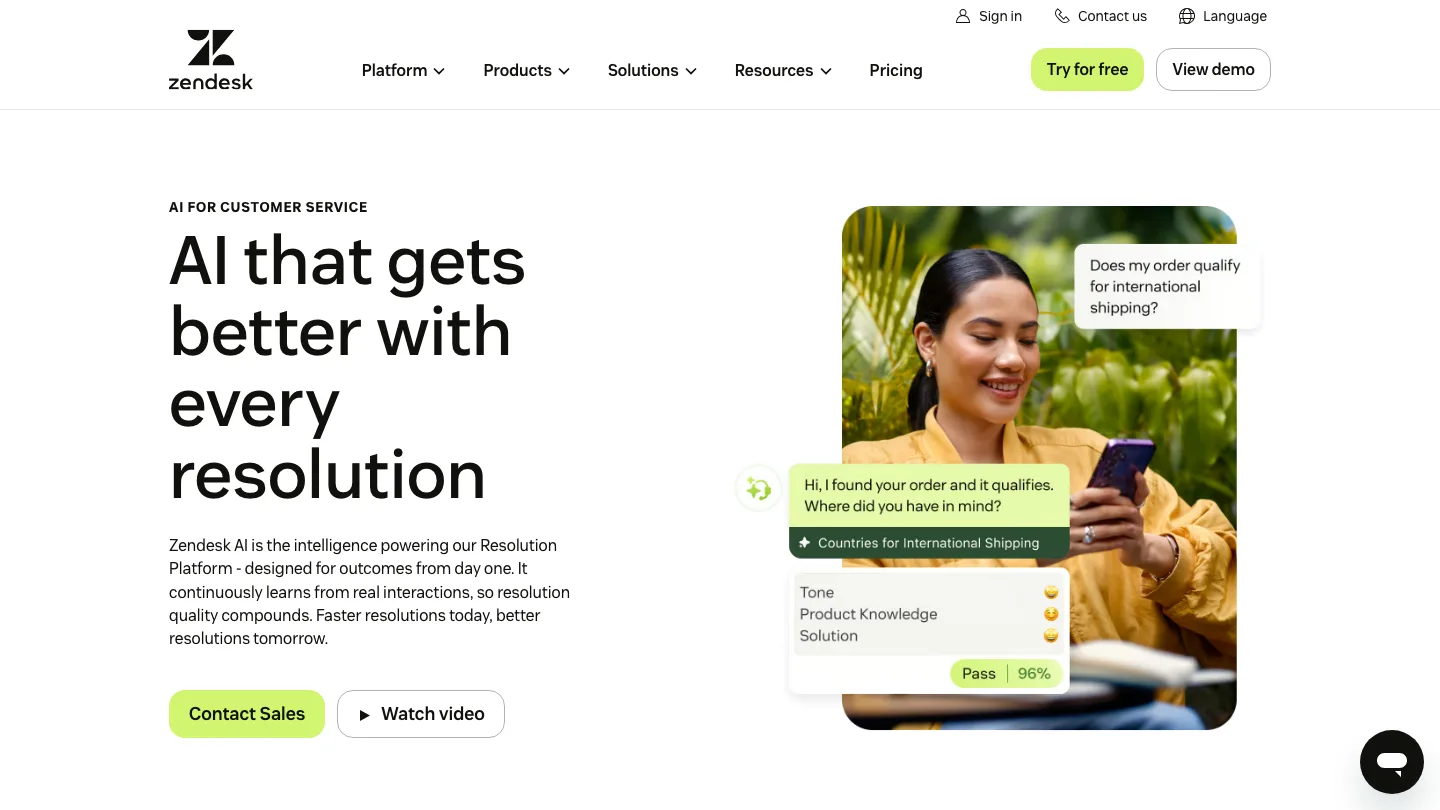
Zendesk AI Agents is an active, customer-facing support automation product for organizations already using Zendesk, with native email ticket handling plus messaging and an early-access voice channel. It is best treated as a support agent rather than a personal email assistant: it can answer from connected knowledge, run multi-step procedures and system actions, and hand conversations to humans, but email has important procedure and formatting limits and the current outcome-based pricing is not fully quantified on the public pricing page.
Features and fit
What Zendesk AI Agents does
Reads the newest customer content in an email ticket, strips quoted history, signatures, footers, and legal notes, identifies a use case, generates a knowledge-grounded answer, executes a generative procedure, calls approved integrations or CRM actions, updates or creates records, and escalates to a human when configured or when the request cannot be completed.
Product type
Customer-support AI agent inside the Zendesk service platform. The correct directory category is support-agent, not personal inbox assistant, sales email coach, or standalone email client.
Email and platform support
Zendesk's email channel, including tickets created by email, web form, or API after the documented trigger configuration. It is not a Gmail or Outlook personal-inbox assistant.
Other channels
Messaging and email are generally documented. Voice is listed as early access in the current agentic-AI documentation. Zendesk's older Talk article still says legacy Essential and Advanced agents cannot answer Zendesk Talk calls, so voice should be labeled EAP rather than generally available.
Email behavior and limits
One generative procedure can run per email response, although separate procedures can run sequentially across later emails in the same chain. Emails that combine a knowledge question with a procedure request, or contain multiple parallel procedure requests, are escalated by default. Control over greetings, layout, signatures, and footers is currently limited.
Knowledge
AI-generated answers require one or more connected knowledge sources. Supported sources include Zendesk help centers plus external sources connected through crawlers or connectors. Zendesk says external content can be reused in AI-agent responses, with up to 50 external sources at the account level; too many sources can reduce accuracy and increase latency.
Procedures and actions
Generative procedures turn a written business policy into a procedure map with blocks for generating answers, asking questions, collecting parameters, branching, searching or answering from knowledge, running API integrations, performing CRM actions, linking to another flow, and escalating to a human. Action Builder resources can include custom actions, action flows, external actions, and MCP connectors.
Human handoff
A procedure can escalate to a human agent or team, at which point the AI agent stops and the procedure ends. Messaging handoff follows the account's routing flow. Conversation logs distinguish assisted escalation, automated resolution, and channel-specific statuses.
Plan/add-on status
Zendesk removed the Essential-versus-Advanced AI-agent distinction in its May-June 2026 rollout and says formerly advanced agentic capabilities are included across Suite and Support plans. Copilot is a separate human-agent assistance add-on publicly listed at $50 per agent/month paid yearly; it should not be confused with the customer-facing AI Agents product.
Automated resolutions
Zendesk's May 18, 2026 framework distinguishes assisted escalation, contained resolution, and verified resolution. A verified resolution is evaluated after 72 hours without customer follow-up by a separate LLM; assisted escalations and contained resolutions are described as not counting against the resolution allowance in the current tier article.
Admin and controls
Client-admin permission is required to create an AI agent. Email automation is governed by editable Zendesk triggers; admins can choose a system sender that consumes no seat or a dedicated configured user that consumes a seat. Knowledge connections require Knowledge-admin access, and current docs describe reporting, testing, reasoning controls, permissions, and conversation logs.
Pricing
Plans and cost
The public annual-pricing page lists Support Team at $19 per agent/month, Suite Team at $55 per agent/month, and Suite Professional at $115 per agent/month. It places AI Agents visibly in Suite Team and higher, while its FAQ and Zendesk's May 2026 packaging announcement say AI-agent access is included across every Suite and Support plan. Usage is additionally measured through automated-resolution allowances and outcome tiers; the public pricing page does not show a single universal per-resolution price, so exact commitment, allowance, overage, and tier economics require a current quote or account-level check.
Free plan or trial
No free plan is shown. Zendesk links to a free trial from the pricing page, but the public page reviewed did not state a duration or whether a card is required.
Privacy and security
What happens to your email data
Zendesk says third-party LLM vendors cannot use Service Data to train their models. Direct model-provider integrations use zero-data-retention endpoints, while models hosted through infrastructure providers are configured so the model provider does not access prompts or outputs. Existing customer agreements, DPAs, and eligible BAAs apply to generally available AI features. These are first-party policy statements, not an independent audit performed for this dossier.
Security certifications and data-handling commitments are attributed to the vendor unless the supporting audit artifact was independently reviewed.
Independent signal
What users are saying
The strongest direct themes were knowledge readiness, configuration burden, outcome-pricing uncertainty, and the need for safe actions and observable handoff. Two recent YouTube tutorials demonstrated no-code setup and knowledge-base dependence, but both came from the same low-reach creator and should not be treated as independent validation. Recent Reddit discussion was more useful, although several threads attracted vendor-authored replies or were created by competing vendors.
Weak. The engine collected 66 items across six returned sources, but only a small subset was clearly about Zendesk AI Agents. The best direct items were four Reddit discussions and two low-engagement tutorials; broad TikTok, Instagram, GitHub, and Hacker News matches were mostly category-level or off-topic.
2026-07-10 through 2026-08-09
An ecommerce thread raised concerns about setup effort, incorrect answers, and paying for successful automated outcomes. Several replies disclosed affiliations with competing vendors, so this is useful buyer-language evidence but not a neutral benchmark.
Direct named-product discussion in the research window; low-to-moderate engagement and commercial bias limit confidence.
A Zendesk-community thread asked how the agent should handle undocumented billing exceptions, past decisions, Slack discussions, and customer-specific promises. The thread does not prove a product failure, but it captures the central implementation risk: incomplete knowledge.
Direct operator concern that aligns with Zendesk's own requirement for connected knowledge sources.
A model stress-test found that plausible but unverified customer claims could trigger unsafe support actions and argued for action-level audit trails. The author disclosed that it sells a Zendesk Marketplace AI agent, so the result applies to support-agent evaluation generally and is not an independent test of Zendesk's native agent.
High-value evaluation pattern with explicit commercial conflict; do not present it as a Zendesk product defect.
A small-team buyer described Zendesk setup as excessive for one support address and three agents. The complaint was about platform complexity rather than a controlled AI-agent evaluation.
Useful fit signal for directory segmentation; low engagement and unverifiable context.
TechRadar reported Zendesk's shift toward verified, outcome-based AI pricing and framed it as an attempt to connect cost to business value.
Independent commercial context, but outside the 30-day signal window and not a hands-on product review.
Limitations
What to know before choosing Zendesk AI Agents
- The product belongs in a customer-support agent category, not the main personal email-assistant category. It does not provide evidence of personal inbox triage, scheduling, relationship management, or general Gmail/Outlook drafting.
- Public packaging changed materially in May-June 2026. Current pages say formerly advanced agentic capabilities are included broadly, but the pricing card visually introduces AI Agents at Suite Team. Treat entitlements as plan- and rollout-sensitive until verified in a buyer account.
- No single current public first-party price for automated-resolution commitments, allowances, tiers, and overages was found. Third-party claims of $1.50-$2.00 per resolution should not be published as universal pricing.
- Email is less flexible than messaging: one procedure per response, default escalation for mixed knowledge-plus-action requests or multiple simultaneous procedures, and limited formatting control.
- Good performance depends on maintained, scoped knowledge and clear business procedures. Recent community discussion repeatedly focuses on undocumented exceptions, private context, incorrect answers, and the need to audit actions.
- Voice is early access in current agentic-AI documentation, while older Talk documentation says native legacy agents cannot answer calls. Do not market voice as fully generally available.
- Legacy Essential and bot-builder functionality has a near-term migration deadline and December 2026 shutdown date. Ensure screenshots and setup instructions come from the unified experience before publishing.
- Several recent Reddit replies and comparison posts are affiliated with competing vendors. Use them to identify buyer concerns, not to make comparative performance claims.
- Zendesk's 80%+ resolution language is a vendor claim, not a dependable forecast for a specific team's email queue.
Evidence
Sources behind this review
Product facts come from current first-party pages. Independent and community sources are used for context—not as proof of every product claim.
Zendesk AI Agents handles messaging and email, including API and web-form tickets, and usage is measured through automated resolutions.
Agentic AI is documented for messaging, email, and voice EAP, with one procedure per email response and default escalation for mixed or parallel procedure requests.
Email replies appear in the customer inbox and Agent Workspace, and trigger configuration governs email, web-form, and API behavior and sender-seat use.
Generative procedures support questions, parameters, branching, knowledge, API and CRM actions, linked flows, and human escalation.
Action Builder resources, external actions, and MCP connectors can be invoked from AI-agent procedures and dialogues.
AI agents can use Zendesk help centers and connected external sources for generated replies; at least one knowledge source is required.
Zendesk supports up to 50 external content sources and makes connected content available to AI-agent responses.
The May 2026 packaging rollout removed Essential/Advanced distinctions and included formerly advanced capabilities across Suite and Support plans.
Public annual prices are $19 Support Team, $55 Suite Team, and $115 Suite Professional per agent/month; Copilot is $50 per agent/month, and AI-agent outcomes add usage-based pricing.
Resolution tiers distinguish assisted escalation, contained resolution, and LLM-verified resolution after 72 hours without follow-up.
Third-party model providers cannot train on Service Data, and direct provider integrations use zero-data-retention endpoints.
Legacy Essential and bot-builder development ends August 31, 2026, with service shutoff planned for December 10, 2026.